|
Home
Investigations Math Section
*Weekly Math Updates*
Weapons of Math Destruction Comics
17th Amendment
 Summer
Adult Soccer Summer
Adult Soccer
Political Ramblings
There Goes the Neighborhood
(AKA "Track Two")
Where Have All The Prophets Gone?
Great Quotes
Founding Fathers
--Christian Nation
Other Political Quotes
Shocking Quotes
Inspirational Quotes
Origin of the Name Oak
Other Articles and Talks
Reviews
Humor (to me at least)
Free Software
Projects
Utahns Against Common Core

Scavenger Hunt Clues & Treasure Hunt Ideas

Outdoor Survival Gear

Math Comics

Utah's Republic - Restoring Constitutional Education

Meet Some Mormons
|
Investigations Math 7/29/05 Update
CORRECTIONS TO THIS PAGE:
After receiving an email from Barry Graff, Alpine School District curriculum person (what's your title Barry?) I have a couple of corrections to make. To see the detail of our email exchange please look at the 8/15/05 Investigation Math update page. Previously I had stated the Nebo district was using Saxon math. That is incorrect. They are using Houghton Mifflin, another traditional math based method and not a "new math" method like Investigations. I'm still a little puzzled where my initial information came from, but I don't discount the base results any for that correction.
Second, Barry informs me that the 7th grade comparison is invalid because Alpine had their special ed students take the test compared to Nebo using their regular 7th grade math students. Please check the 8/15/05 Investigation Math update page for more information about this.
END CORRECTIONS
Sign the Petition
to rid us of Investigations Math
If you are about to tune this page out because it's lengthy, at least scroll
down to view the 7th grade math comparison charts between Alpine and Nebo.
Socio-economic factors are the leading indicator of school success overall,
and Alpine is clearly the more affluent of the two districts. That makes it
all the more impressive that by 7th grade, Nebo students are 20% above Alpine
students at the highest level of math mastery. Nebo uses a direct instruction
method called Saxon math, while Alpine uses Investigations math.
May I remind those of you about to read this page, that though I was put off
by Investigations the first time I saw what it was, I respected the opinion
of our school principal that it was a good program. Until I decided to find
out for myself what this program was all about and form my own opinion based
on information I could find, I was prepared to completely accept this program.
Someone named Shoseki said, "Truth only reveals itself
when one gives up
all preconceived ideas." To those of you that may be upset with the
resources and comments I have below, please try to be open minded and let
the information
be weighed in a proper balance. Don't force the scale due to your pleasure
that your child is bringing home good grades. Grades don't reflect learning
and please don't ask me to prove that. Go read a book on Einstein's life.
A lot has happened since I first published the Investigations Math information.
First of all a disappointing show in the raw number of people I'm reaching,
but I guess I have to blame myself for a lack of marketing skills and hoping
that in sending out a couple hundred emails would actually generate a grassroots
effort to save our kids education. I need YOUR help to spread the word. I'm
just a pebble in a pond (or however that saying goes). Please toss your pebble
in with mine and make a bigger splash.
Real Life Stories
I now know personally of many people that have pulled their kids out of the
school system to homeschool or put children in charter and private schools.
Almost all of them had taken to supplementing their children's educations at
home because they recognized the great weakness of Investigations math. More
than one parent have described how putting their children in charter schools
have caused their children to be put back one or more grade levels in math.
In one instance, a former employee of the school district, who thought she'd
just let the school district program work as it was designed to, wound up putting
her 4 children in charter school and all 4 of them were put back 2 grade levels.
That's exactly Dr. Wilfried Schmid's point (see 1st document below), that Investigations
puts kids behind.
School Board Meeting
I attended the school board meeting on Tuesday July 19th. You may read my
public remarks here.
Met with Barry Graff, Curriculum person at the district
As a result of the school board meeting I obtained an appointment to meet
with Barry Graff, the district curriculum specialist, on Friday July 22nd.
David Cox, a teacher in the district and state legislator went with me to
the meeting. In preparation for the meeting I put together a packet of resources
for Barry which I will list and link to below along with a brief description
of what each one contains. He also answered some of the
questions I had asked at the school board meeting and pointed me to some
additional resources touting Investigations Math, the state board of education's
sample questions for the state core standards, and comparisons of scores
between
schools in the district. This is most enlightening stuff and you really need
to check out the comparisons I have provided to see the difference between
curriculum (hmmm, not sure if that's plural...maybe curriculi?). For a synopsis
of the answers he gave me regarding my public remarks at the board meeting
and
a brief
summary
on
our
meeting, click
here.
List of resources given to Barry:
- Harvard's
Dr. Wilfried Schmid's (MS Word Doc) opening remarks at a NY conference that
TERC students are 2 years behind by 5th grade.
- Testimony
of James Milgram (MS Word Doc) , Stanford research mathematician, to congress
that there is NO research evidence that TERC programs are effective and the
NSF programs set too low a standard
- Jan
Mokros' "study" on TERC Investigations debunked
- Open
letter to Secretary of Education (MS Word Doc) , Richard Riley, from Dr. David Klein
at CSU and signed by over 200 professors of math including 7 Nobel Laureates,
that the NSF endorsed math programs were never reviewed by REAL mathematicians
and some of the programs touted actually remove fractions and multiplication
from their curriculum. (though TERC is not specifically mentioned on the
list because it came out shortly after these programs, they are all from
the same mold where teachers faciliate classes instead of teaching directly)
- Fordham
foundation report with Utah ranking 35th in the nation for math
curriculum due to lack of memorization, reliance on calculators, overuse
of manipulatives
- "The havoc wrought by today's "modern" math" by Dr. Charles
Ormsby (PhD MIT). Dr. Ormsby maintains the opposite of TERC that "teaching
the techniques first, and then exploring the underlying concepts and why
these techniques work
is the most efficient way to achieve true understanding."
- TIMSS international
benchmarks which show 93% of Singapore's 8th grade
students reach the intermediate international benchmark, while in the U.S.
only 64% do. We only have 90% that reach the low mark.
- * Testimony
of John Hoven (MS Word Doc), PhD economist, bachelor's in math and physics,
and master's degree in physics. Because Singapore is "the acknowledged
world leader in mathematics," Dr. Hoven compares their math program
to the U.S. NAEP guidelines (national assessment of educational progress).
He compares
U.S.
math problems
with Singapore and graphically shows that Singapore students are doing problems
in 3rd-5th grade that rival our 8th grade level because we have lowered the
bar so much. Look a the document and see what I mean.
- Jeff Lindsey's report
on Wesley Elementary school in Houston. As you'll
read below, socio-economic factors are huge in education. Wesley was a school
doomed for failure under this logic since 99% of the school is minority.
Yet somehow they were placing in the 82nd percentile. The reason? Direct
instruction by the teachers to the students instead of teachers acting like
facilitators. Teaching kids works!
- Washington
Post article on Maryland schools falling apart from constructivist
math programs (meaning teachers act as facilitators instead of teaching)
- Conundrums
for Constructivists (MS Word Doc) by David Cox. David reports on a study performed
by constructivists where they themselves admit maybe they're not onto something
after all.
- The
Difference in Research (MS Word Doc) by Dr. George Cunningham. Dr.
Cunningham points out that there is no research to compare math methodologies
and
when constructivists
were invited to have a real scientific comparison by taking children that
were just coming into school and having two groups be taught by direct
instruction vs. constructivist methods, the people offering to do the study
were called racist, anti-feminist, and other labels.
- Letter
to President Clinton by educators begging him to read E.D. Hirsch's
book, The Schools We Need: And Why We Don't Have Them. The letter
is signed by about a hundred math educators at prestigious universities.
I am purchasing a copy for Barry Graff as well as myself to better understand
this issue. Publisher's weekly describes the book as follows:
Bestselling author Hirsch (Cultural Literacy) argues that American
education, kindergarten through high school, has been undermined by
a deep contempt for factual knowledge and an addiction to fads such
as "project-oriented" instruction, "relevant" topics, "child-centered" activities
and building students' self-esteem. In a damning, highly provocative,
full-scale assault on today's educational establishment, this University
of Virginia English professor calls for a return to a so-called traditional
approach emphasizing drill, verbal practice, memorization and interactive
classroom instruction. Hirsch, who advocates a grade-by-grade core
curriculum, buttresses his pragmatic tack with cognitive-psychology
research and international comparative studies of classroom practice.
An enjoyable 30-page glossary demystifies educators' slogans, pet phrases
and jargon. A rigorous polemic.
Barry maintains that no curriculum is a "silver bullet" and all
have holes. They have recognized a lot of holes in the Investigations Math
program since
inception and they have certainly made some progress in filling in those holes.
My point is that the difference between Investigations Math and other curriculum
is that Investigations has bigger and substantially more holes than other rigorous
programs and if we were to implement another program we could have a more cohesive
program rather than tossing patches at this one. Besides, if Investigations
was such a great curriculum, why patch anything?
SES (socio-economic status) Factors - Now it gets interesting (Traditional vs.
Investigations)
Now for the really interesting stuff. One of the things that came out of the
meeting with Barry Graff is the importance of taking into account SES (socio-economic
status) in determining how good scores really are. For example, lower
economic class schools should have lower grades if all things are held equal
when
compared to an affluent area. I think it would be safe to say that the Alpine
school
district is overall a fairly affluent area.
Some of the packets Barry gave me when I left his officer were CRT test
results for grades in various districts around the state that are somewhat
comparable
in
size.
I
took that information and tossed it into a spreadsheet and started plotting
some graphs (the curse of being a CPA). I chose to compare Alpine with the
Nebo school district because Nebo uses Houghton-Mifflin math and they are in a lower SES
than
Alpine
since
they
take in Spanish Fork, Salem, Mapleton, Santaquin, Payson, etc... Honestly,
there are a few things I'm not 100% certain on because the numbers Barry Graff
gave me were actually much worse for Alpine, showing about 40% of the students
failing 7th grade. I wound up contacting Seth Sorensen at the Nebo school district
who looked up Alpine and Nebo numbers again for me online at the COGNOS site
run by the state and gave me much better figures for Alpine which trend similarly
to Nebo so I have
a
lot
more
confidence in the numbers. (see additional updates to this on the 8/15/05 update page)
Just today 7/29/05, I spoke with Patty Murphy at the state board of Education
and got some SES data on these two districts. The data was mostly retrieved
from the National Center for Education Studies (nces.ed.gov) and the Utah State
Office of Education (www.usoe.k12.ut.us). What the data shows is that Nebo
is definitely a lower SES location in terms of poverty, but I just wasn't willing
to put together yet another spreadsheet listing all the towns in both districts
to try and come up with an average income level for households. I'm going to
make a wild assumption that Alpine school district has a higher median income
than Nebo. Also, in an effort to be fair and objective, I have included statistics
that show Alpine has a higher percentage of students in some type of limited
English program.
School District |
Poverty % |
% children on free & reduced lunch |
% students in limited English program |
Alpine |
8.4%
|
24.78% |
5.8% |
Nebo |
9.3%
|
28.83% |
4.6% |
3rd Grade Comparison
Mastery Level: Higher is better
Levels 1 & 2: Not Passing
Levels 3 & 4: Passing
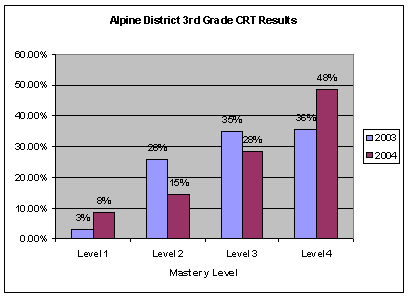
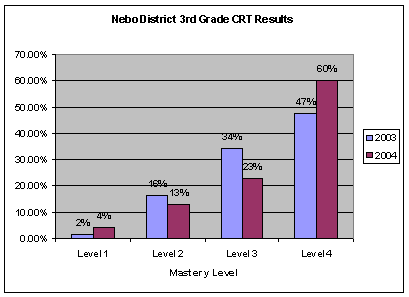
Comparing the 3rd grade results we see similar trends (increases and decreases)
between 2003 and 2004 for both Alpine and Nebo districts which I suppose
could
be due
to
test questions
that differed between years. However, the more important factor is that 83%
of students in Nebo are passing while 76% in Alpine are. Also, the Nebo students
have a higher level of mastery than Alpine. An impressive achievement when
you consider that SES factors are opposite what this table should show.
5th Grade Comparison
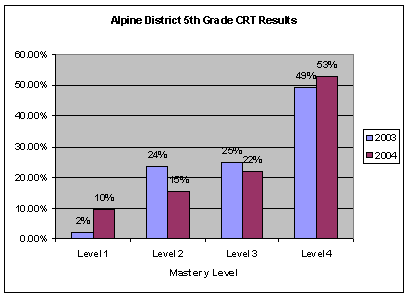
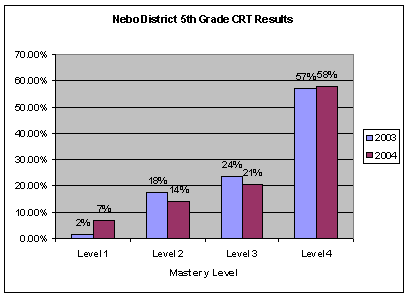
Again, similar to the 3rd grade results, Nebo has a 5% higher population
of students in the 4th level of mastery of math facts, while the 3rd mastery
level is 1% lower. The children in Nebo just seem to be a little
bit ahead of Alpine.
Comparison of State Board math problems compared to Singapore math
OK, after the prior graphs, I wish I had some Saxon problems to compare
to our state board core problems, but what I do have is Singapore math
books since that what we've been using to supplement our children's math
this summer. I think after you see this, you'll see that our state board
of education could
be where
the
underlying
problem
comes from. (Also note the comparison document near the top where I've
put a red asterisk next to item 8 which compares national test bank questions
to
Singapore math questions)
Barry gave me the website www.utips.org (Utah
test item pool server) to see what kind of math problems the state board
generates as part of their core standards that children are supposed to
be able to do in each grade. I downloaded 4th grade math problems across
their whole core curriculum to compare with the 4th grade Singapore math
book my daughter uses. Some of these state problems are downright ridiculous
for 4th graders such as the 4th problem below. My first grader could do
that and maybe even my pre-schooler.
Sample 4th grade Utah core problems |
1) What is 5,090.4 in words?
A. five thousand ninety-four tenths
B. five thousand ninety and four tenths
C. five thousand nine and four tenths
D. five hundred nine and four tenths |
2)
LaToya made popcorn using different amounts of kernals.
| Kernal (cups) |
Popcorn (cups) |
| 1 |
6 |
| 2 |
12 |
| 3 |
18 |
| |
|
| |
|
The table above
shows how much popcorn she
popped each time.
How many cups of popcorn will LaToya have if she pops 5 cups
of kernals?
A. 30 cups
B. 20 cups
C. 36 cups
D. 24 cups
|
3) About how tall is a doorway?
A. 2 meters
B. 20 meters
C. 2 centimeters
D. 20 centimeters |
4) The table shows the number of pizzas sold each day for five
days.
| Day |
Pizzas Sold |
| 1 |
111 |
| 2 |
97 |
| 3 |
74 |
| 4 |
105 |
| 5 |
83 |
Which day had the lowest number of pizzas sold?
A) 3
B) 5
C) 2
D) 4
|
Links to the PDF's where these problems came from (if you want to see
for yourself):
Problem 1
Problem 2
Problem 3
Problem 4
4th Grade Singapore Math Problems
Now here's a few of the Singapore math problems. Notice how the some of
the problems are multi-step. You have to do two problems to find the answer,
and they require you to think about math while
performing a real-world problem. In Investigations
you are taught to think about math in the classroom and then work
on far simpler problems or cut out images and paste them together, or other
"manipulative" projects. Now I know the school district has made changes
here and our kids are bringing home some of the more "traditional" math
homework, but wouldn't it be better to have a core curriculum that didn't
have so many holes that needed patching. Wouldn't it be better to have
problems that teach comprehension as you solve them?
Parents would love to help their kids understand this kind of homework
and the kids would build their self-esteem for having solved these challenging
problems.
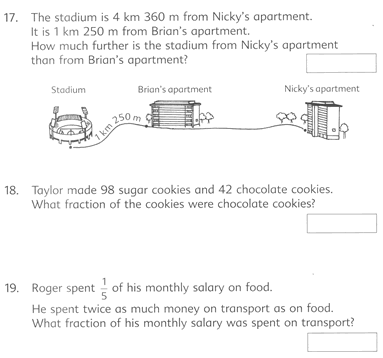
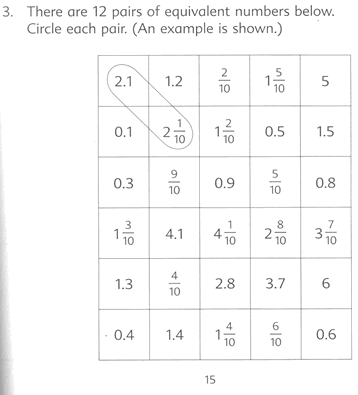
Now which set of problems do you want your child struggling with in 4th
grade? Which do you think will teach them more? The state core problems
just don't stack up to a rigorous curriculum (please note the first problems
are from the state and not necessarily equivalent to Investigations math
though the schools derive their problems from what the state publishes).
It isn't that Singapore math problems are terribly more challenging,
but they are more comprehensive. Investigations math advocates say one
of the
purposes
of the program is to teach children to understand math concepts by discussing
them and pondering math relationships. I challenge that notion
and believe that solving comprehensive problems is what brings comprehension
of math. The process of thinking through a problem is where learning takes
place. You learn by doing.
It seems to me that ultimately the core of this whole problem is that
our state board of educators has set low standards. When districts try
to hit
low
standards,
they succeed, but
at the
detriment of our children. We need to raise the bar and have our children approach
math with the understanding that a challenging course is the best path to superior
mastery of math skills. Even if their grades drop, which they should in a more
challenging course, they'll know more and be better prepared for algebra and
college. After all, self-esteem doesn't come from people telling you how good
or smart you are, it comes from tackling hard math problems and getting the
RIGHT ANSWER!
Alpine School District Interventions Packet
Just when I thought I could wrap up this page,
I opened up a binder Barry gave me that every teacher is being given
for the upcoming
year.
This is
one
of the "hole patches" the school district has developed. It's
called "Basic
Facts Benchmark and Intervention Toolkit."
I think it's
called
that
so the teacher has a resource to assess and "intervene" when
students are having problems and they want to make sure they're up to
speed on the
core
curriculum.
In looking through the book at the 4th grade "interventions" the
only thing that's really there is a page of multiplication problems up
to 9
x 9. Over 30 years ago in 3rd grade I had to have my times table down to
12 x 12 and we had times tests constantly to get those facts down pat.
I'd guess most of you grew up that way as well and somehow managed to become
engineers and accountants and stay-at-home moms and everything else that
uses math (which is literally everything).
The beginning of the interventions
book informs teachers that while students are learning their addition
and multiplication
facts,
it
is inappropriate to give them times tests because they are just learning
their "strategies." I'm sorry, but I thought by 3rd-4th grade,
children should realize that multiplication is simply a grid of so many
numbers wide by tall and that they didn't
need to formulate a strategy to deal with that kind of problem.
We are also informed in the binder that "all
students should be fluent with facts for 0s-5s and 10s by the end of
third grade." I
thought that over 30 years we'd be finding better ways to teach kids and
perhaps they should have that set of skills down
by first or
second grade (as Singapore math and others do in their curriculum)
and have all numbers through 12 down by the end of third grade.
The "correct" answer
here, I believe, is we should, and Singapore does, and that's why they're
#1 in the world because they expect that tiny bit more out of kids at a
younger
age. It really isn't a revolutionary concept here. It's just
teachers giving direct instruction to their students and expecting them
to learn what they teach and do it a tiny bit earlier in school (than we
currently expect, but was done for decades previously) so that when they
get through
6th grade, they're way ahead of where they would have been because
they've been pushed a tiny bit
more all along the way.
If you've read this far, I'm begging you, please contact the Alpine School
District and tell them you've read this website and see a clear need for
a better math program. Saxon math would be a great pick. I've never yet
met anyone that didn't love the program (unlike the thousands that don't
like Investigations math in this district) and the results of Nebo's district
clearly show Saxon works well.
If you'd like to contact the school district, here's a link to their contact
page.
Use the School Administration phone number. Their webform doesn't seem
to be working at the moment. THEN,
SIGN THE PETITION to have the district let principals make their own
math choice decisions to switch to a direct instruction program
such as Saxon math.
Investigations Math Menu
** Most important pages to read (all have value but if you will only read
a few pages make it these)
* Very important
|